


Narcissus Angustifolius
Flowers



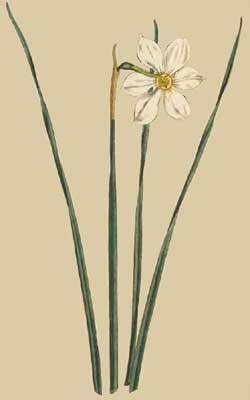
Narcissus Angustifolius
Under the name of poeticus three different species of Narcissus appearing perfectly distinct (though similar in many respects) and regarded as such by the old Botanists, have been confounded by the moderns, viz.
Narcissus albus circulo purpureo, v et vi.
Narcissus albus magno odoro flore circulo pallido,
Narcissus pallidus circulo luteo. C. Bauh.
Narcissus medio purpureus pr?cox,
Narcissus medio purpureus serotinus,
Narcissus medio luteus vulgaris. Park Parad.
The first of these, the one here figured is evidently the poeticus of Linn?us, judging by the authors to whom he refers in the third edition of his Spec. Pl. which are indeed few in number, and confined chiefly to Bauh. Pin. Dodon?us, of the second, and third, he takes no notice.
The two former ones of these have the greatest affinity, inasmuch as they both produce for the most part only one flower, of a white colour, having a very short nectary, edged with orange, to both of these Linn?uss specific description is equally applicable, as well as the trivial name of poeticus, given them indiscriminately by several of the old Botanists, some regarding the first, some the second as the plant mentioned by Theocritus[2], Virgil[3], and Ovid[4], unfortunately both of them are found to grow in the same meadows, and have the same obvious appearances, it is therefore utterly impossible to say which of the two was the Narcissus of the poets, if we have the greatest difficulty in ascertaining what the plants were of the Botanists of those times, how are we to discover what the Poets meant, who with very few exceptions have been unpardonably inattentive to the appearances of nature. Since then the term poeticus is equally suitable to both, and as there cannot be two with the same name, we have thought it best to get rid of it altogether, and substitute others which tend in a certain degree to discriminate the several species, denominating the
1st. angustifolius.
2d. majalis.
3d. biflorus.
The angustifolius here figured is a native of the South of Europe, and said by Magnol and Clusius to grow spontaneously in the meadows about Narbonne and Montpelier.
It flowers in our gardens early in April, about a month before the biflorus, and full six weeks sooner than the majalis, increases readily by offsets, and succeeds best in a soil that is moderately moist. In what respects it differs from the two others, will be mentioned when they come to be figured.

 Limodorum Tuberosum
 Scilla Campanulata
 Ranunculus Aconitifolius
 Saxifraga Sarmentosa
 Arabis Alpina
 Amaryllis Atamasco
 Fumaria Glauca
 Lilium Catesb i
 Lamium Orvala
 Centaurea Glastifolia
 Test your English Language
  Weird and Wonderful Amazonian Wildlife
 Creative Valentines Day Gift
 Refreshing Summer Drinks
 Amazing Facts You Probably Didnt Know Things That Men Think Women Can Never Learn
 Christmas Poems
 Healthy Elbow
 Solar System Rules to play Wheelchair Tennis
 Benefits of Mushroom Rules to play Knee Boarding
 Tips To Lose Weight
 Benefits of Star Apple Craziest Eating Contests From Around The World The Rabbit and Tortoise
 Ratan Tata
 RavindraNath Tagore Reality TV Shows That Are Far From Reality