Ayurvedic Medicine
91. Turmeric
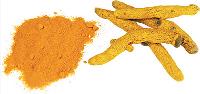
Turmeric (E), Haldi (H):
Turmeric is a perennial grown throughout the tropical parts of Asia. It favours a warm and humid climate. Haridra- literally means 'yellow' and its strong yellow colour signifies its use as a liver herb that is good at drying damp and moving stagnation in the blood.
Digestion For all intestinal infections and mucus conditions. Turmeric helps to promote 'sweet' intestines by reducing pathogenic bacteria and destroying ama. It has recently been proven to have an affinity for the large intestine and to play a preventative role in bowel cancer. Other clinical trials have proven its efficacy at treating dyspepsia and stomach ulcers. Its bitter and pungent flavours act on the agni of rasa dhatu and enhance its ability to nourish the plasma and blood. Traditionally used in diabetes to clear ama, kapha and excess fat tissue (Paranjpe 2001, Bone 2003). Liver A stimulant effect to the liver and ran˜jaka pitta increases the flow of blood through the hepatic system and increases bile output. This helps to dissolve and prevent gallstones. It is traditionally considered a blood 'purifier' and is often used for beautifying the skin and clearing systemic toxaemia; eczema, urticaria, psoriasis and acne. As with many liver herbs it is also good for the eyes; a wash is used in conjunctivitis and styes. Gynaecology Turmeric is used to clear kapha accumulations from the lower abdomen, uterus and apanaksetra. Fibroids, cysts, endometriosis, dysmenorrhoea, amenorrhoea and leucorrhoea are all treated by reducing congestion. As a specific herb for rasa dhatu it also works on its secondary tissue stanyasrotas and is used to purify breast milk as well as to promote the flow of the menses. A poultice can be very effective in mastitis (Atreya 1998). Inflammation Curcumin reduces inflammation caused by arachidonic acid (cf usage for dysmenorrhoea). It is used in dermatitis, eczema, urticaria, psoriasis, colitis, asthma, rheumatoid arthritis, osteoarthritis. Hence it is used in pitta–kapha conditions at low doses and mixed with other bitter herbs. It is also a renowned antibacterial. Joints It treats inflammation of the joints, alleviates pain and strengthens the joints and tendons. Useful for treating gout, arthritis, broken bones and wounds. Heart Turmeric nourishes the heart by virtue of its raktavardhaka and blood building quality. By increasing blood flow and reducing total cholesterol turmeric helps the functions of the heart. It has an antiplatelet activity and scrapes accumulations from the channels (lekhaniya) which helps to prevent coagulation and reduce kapha in the blood. Infections Turmeric is an excellent antibiotic useful in fevers, sore throat and septicaemia. External Excellent for reducing pain as a topical application in bruises, infections, sprains and pain. Use it carefully as it stains the skin and anything it comes into contact with.
Turmeric is a perennial grown throughout the tropical parts of Asia. It favours a warm and humid climate. Haridra- literally means 'yellow' and its strong yellow colour signifies its use as a liver herb that is good at drying damp and moving stagnation in the blood.
Digestion For all intestinal infections and mucus conditions. Turmeric helps to promote 'sweet' intestines by reducing pathogenic bacteria and destroying ama. It has recently been proven to have an affinity for the large intestine and to play a preventative role in bowel cancer. Other clinical trials have proven its efficacy at treating dyspepsia and stomach ulcers. Its bitter and pungent flavours act on the agni of rasa dhatu and enhance its ability to nourish the plasma and blood. Traditionally used in diabetes to clear ama, kapha and excess fat tissue (Paranjpe 2001, Bone 2003). Liver A stimulant effect to the liver and ran˜jaka pitta increases the flow of blood through the hepatic system and increases bile output. This helps to dissolve and prevent gallstones. It is traditionally considered a blood 'purifier' and is often used for beautifying the skin and clearing systemic toxaemia; eczema, urticaria, psoriasis and acne. As with many liver herbs it is also good for the eyes; a wash is used in conjunctivitis and styes. Gynaecology Turmeric is used to clear kapha accumulations from the lower abdomen, uterus and apanaksetra. Fibroids, cysts, endometriosis, dysmenorrhoea, amenorrhoea and leucorrhoea are all treated by reducing congestion. As a specific herb for rasa dhatu it also works on its secondary tissue stanyasrotas and is used to purify breast milk as well as to promote the flow of the menses. A poultice can be very effective in mastitis (Atreya 1998). Inflammation Curcumin reduces inflammation caused by arachidonic acid (cf usage for dysmenorrhoea). It is used in dermatitis, eczema, urticaria, psoriasis, colitis, asthma, rheumatoid arthritis, osteoarthritis. Hence it is used in pitta–kapha conditions at low doses and mixed with other bitter herbs. It is also a renowned antibacterial. Joints It treats inflammation of the joints, alleviates pain and strengthens the joints and tendons. Useful for treating gout, arthritis, broken bones and wounds. Heart Turmeric nourishes the heart by virtue of its raktavardhaka and blood building quality. By increasing blood flow and reducing total cholesterol turmeric helps the functions of the heart. It has an antiplatelet activity and scrapes accumulations from the channels (lekhaniya) which helps to prevent coagulation and reduce kapha in the blood. Infections Turmeric is an excellent antibiotic useful in fevers, sore throat and septicaemia. External Excellent for reducing pain as a topical application in bruises, infections, sprains and pain. Use it carefully as it stains the skin and anything it comes into contact with.
92. Vacha
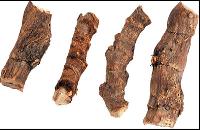
Calamus root (E), Sweet flag (E), Vach (H):
Vacha literally means 'speech'. Calamus thrives in wet, damp marshland and is a semi-aquatic perennial. Its qualities treat similar 'terrain' in the whole system; sluggish, congested, heavy and wet conditions, like those of a marshland, are opposed by the warm, drying, penetrating and stimulating qualities of vacha.
Mind Its primary application is to open the mind, improve concentration, clarity and speech. Its stimulating effect on majja dhatu makes it useful in treating depression and mental sluggishness where there is mental ama. It actually scrapes mental ama and stagnation from the subtle channels of the mind. This acrid root is also used in childhood developmental problems and in post-stroke speech difficulties. It encourages the flow of udana and prana vayu. By nourishing sadhaka pitta it specifically strengthens the ability of the mind to receive information and recall from memory. Digestion Its aromatic heating effect helps to calm the gastric nerves, prevent fermentation and clear excess kapha with dyspepsia, flatulence and borborygmus; vacha reduces both samana vayu and kledaka kapha. It is a rejuvenative to medas-dhatvagni and can help to reduce obesity. Lungs Vacha clears damp, wet coughs from the lungs. It also has an affinity for the throat and vis´uddhi cakra; it clears 'obstructions' from the throat. Its purgative effect on the head makes it an excellent remedy for sinus congestion, nasal polyps and rhinitis from kapha aggravation. High doses can cause vomiting and it is used as an emetic in panca karma. Urine Used traditionally for urinary gravel and infections by removing the kapha deposits.
Vacha literally means 'speech'. Calamus thrives in wet, damp marshland and is a semi-aquatic perennial. Its qualities treat similar 'terrain' in the whole system; sluggish, congested, heavy and wet conditions, like those of a marshland, are opposed by the warm, drying, penetrating and stimulating qualities of vacha.
Mind Its primary application is to open the mind, improve concentration, clarity and speech. Its stimulating effect on majja dhatu makes it useful in treating depression and mental sluggishness where there is mental ama. It actually scrapes mental ama and stagnation from the subtle channels of the mind. This acrid root is also used in childhood developmental problems and in post-stroke speech difficulties. It encourages the flow of udana and prana vayu. By nourishing sadhaka pitta it specifically strengthens the ability of the mind to receive information and recall from memory. Digestion Its aromatic heating effect helps to calm the gastric nerves, prevent fermentation and clear excess kapha with dyspepsia, flatulence and borborygmus; vacha reduces both samana vayu and kledaka kapha. It is a rejuvenative to medas-dhatvagni and can help to reduce obesity. Lungs Vacha clears damp, wet coughs from the lungs. It also has an affinity for the throat and vis´uddhi cakra; it clears 'obstructions' from the throat. Its purgative effect on the head makes it an excellent remedy for sinus congestion, nasal polyps and rhinitis from kapha aggravation. High doses can cause vomiting and it is used as an emetic in panca karma. Urine Used traditionally for urinary gravel and infections by removing the kapha deposits.
93. Vamsa Lochana

Bamboo manna, the inner pith of bamboo (E), Vamsa-locana (H):
Although all parts of the bamboo are used, in Ayurveda true Vamsa lochana is found inside the hollow bamboo at the internodes as a silica-like secretion. Vam. s´alocana literally means 'bamboo eye', referring to the exudates of the silica appearing through an eye-like crack in the bamboo. Its rarity is due to the difficulty of its harvest. It is especially good at clearing lung infections.
Lungs Cough from high kapha and pitta indicated by an infected cough producing yellow- green sputum, which may be blood-streaked; asthma, bronchitis, pneumonia. It enters rasa dhatu and helps to clear fevers from ama and pitta in the plasma. It has nourishing and tonic properties that help to repair and strengthen lung tissue. Heart As a rejuvenative to avalambaka kapha it has cardioprotective qualities and is used with signs of chest pain, heaviness and congested blood flow. Bleeding Its haemostatic effect on rakta dhatu make it a useful herb to include as a part of a formula for bleeding from high pitta anywhere in the body. Urine Its diuretic effect on mutravahasrotas can help with cloudy and concentrated urine with a pungent smell due to high pitta. It also benefits dysuria from high vata.
Although all parts of the bamboo are used, in Ayurveda true Vamsa lochana is found inside the hollow bamboo at the internodes as a silica-like secretion. Vam. s´alocana literally means 'bamboo eye', referring to the exudates of the silica appearing through an eye-like crack in the bamboo. Its rarity is due to the difficulty of its harvest. It is especially good at clearing lung infections.
Lungs Cough from high kapha and pitta indicated by an infected cough producing yellow- green sputum, which may be blood-streaked; asthma, bronchitis, pneumonia. It enters rasa dhatu and helps to clear fevers from ama and pitta in the plasma. It has nourishing and tonic properties that help to repair and strengthen lung tissue. Heart As a rejuvenative to avalambaka kapha it has cardioprotective qualities and is used with signs of chest pain, heaviness and congested blood flow. Bleeding Its haemostatic effect on rakta dhatu make it a useful herb to include as a part of a formula for bleeding from high pitta anywhere in the body. Urine Its diuretic effect on mutravahasrotas can help with cloudy and concentrated urine with a pungent smell due to high pitta. It also benefits dysuria from high vata.
94. Varuna

Three-leafed caper (E), Varuna (H), Varna (H):
The bark of varuna is a renowned diuretic helping to clear pain and stones from the bladder and kidneys.
Urinary Its affinity for mutravahasrotas coupled with its bhedaniya property clears urinary deposits and urinary pain in cystitis and inflammation. It clears kidney, ureter and bladder stones. It is also used for other urinary symptoms with urinary incontinence, enuresis, hypotonic, atonic and neurogenic bladder. Used in benign prostatic hyperplasia, cystitis, interstitial cystitis and chronic urinary tract infections. Lymph Its effect on both rasa and medas-dhatu helps to clear inflamed lymphatic nodes, especially in the neck. It also helps to clear fatty deposits from the blood and to reduce lipid cells. Digestion It balances vis.amagni in vata types and directs apana vayu downwards. This helps to clears worms and abdominal distension.
The bark of varuna is a renowned diuretic helping to clear pain and stones from the bladder and kidneys.
Urinary Its affinity for mutravahasrotas coupled with its bhedaniya property clears urinary deposits and urinary pain in cystitis and inflammation. It clears kidney, ureter and bladder stones. It is also used for other urinary symptoms with urinary incontinence, enuresis, hypotonic, atonic and neurogenic bladder. Used in benign prostatic hyperplasia, cystitis, interstitial cystitis and chronic urinary tract infections. Lymph Its effect on both rasa and medas-dhatu helps to clear inflamed lymphatic nodes, especially in the neck. It also helps to clear fatty deposits from the blood and to reduce lipid cells. Digestion It balances vis.amagni in vata types and directs apana vayu downwards. This helps to clears worms and abdominal distension.
95. Vasa

Malabar nut (E), Vasaka (H), Adusa (H):
Vasa means 'perfume' and is a common evergreen perennial shrub growing all over the plains of India and Sri Lanka. It is a powerful bronchodilator and expectorant for use in respiratory conditions with high kapha and pitta.
Lungs It is a specific for respiratory congestion and wheezing. As a powerful bronchodilator it eases breathlessness and bronchospasm. It clears inflammatory pitta heat and liquefies congestive kapha. It can be used where there is inflammation from an allergic response as it clears the lungs and nostrils. Its diaphoretic properties act on rasa dhatu and can be utilised in fevers to clear ama and displaced pitta. As it disperses stagnation and strongly scatters prana vayu it can aggravate vata. Blood It is eulogised in the Sanskrit literature for stopping bleeding (raktastambhana). Its effect on raktapitta is to astringe the mucous membranes and it is effective in bleeding from ulcers, menorrhagia, epistaxis and the gingivitis with high pitta. Skin Its ability to clear heat from rakta dhatu and cool bhrajaka pitta make it a useful herb for inflammatory skin diseases with a pitta–kapha pathology. Its mild diaphoretic action can help to clear kapha toxins trapped in rasa dhatu. Gynaecology Its astringency causes contraction of the uterus. This can be useful in bleeding and prolapse. Its oxytocic properties make it useful as a parturient to facilite labour but it should not be used at any other stage during pregnancy. Heart Vasa stimulates the vagus nerve and causes vasodilation of the capillaries. This can help to increase the contractile ability of the heart and also lower blood pressure.
Vasa means 'perfume' and is a common evergreen perennial shrub growing all over the plains of India and Sri Lanka. It is a powerful bronchodilator and expectorant for use in respiratory conditions with high kapha and pitta.
Lungs It is a specific for respiratory congestion and wheezing. As a powerful bronchodilator it eases breathlessness and bronchospasm. It clears inflammatory pitta heat and liquefies congestive kapha. It can be used where there is inflammation from an allergic response as it clears the lungs and nostrils. Its diaphoretic properties act on rasa dhatu and can be utilised in fevers to clear ama and displaced pitta. As it disperses stagnation and strongly scatters prana vayu it can aggravate vata. Blood It is eulogised in the Sanskrit literature for stopping bleeding (raktastambhana). Its effect on raktapitta is to astringe the mucous membranes and it is effective in bleeding from ulcers, menorrhagia, epistaxis and the gingivitis with high pitta. Skin Its ability to clear heat from rakta dhatu and cool bhrajaka pitta make it a useful herb for inflammatory skin diseases with a pitta–kapha pathology. Its mild diaphoretic action can help to clear kapha toxins trapped in rasa dhatu. Gynaecology Its astringency causes contraction of the uterus. This can be useful in bleeding and prolapse. Its oxytocic properties make it useful as a parturient to facilite labour but it should not be used at any other stage during pregnancy. Heart Vasa stimulates the vagus nerve and causes vasodilation of the capillaries. This can help to increase the contractile ability of the heart and also lower blood pressure.
96. Vidanga

Embelia (E), Viranga (H), Vaividanga (H):
Vidanga is a renowned remedy for treating digestive disorders, especially those characterised by abdominal bloating caused by worms.
Digestion Traditionally used to clear vata from the intestines. It specifically kills bacterial, fungal and worm infestations (round-, thread- and tape-) and is considered gentle enough to treat childhood worms. Powdered vidanga is taken with honey on an empty stomach and then castor oil is used as a purgative the following day to flush out the dead worms. It strengthens agni very effectively and hence treats the underlying cause of parasitical infestations. Also benefits stagnation in the purisavahasrotas and frees constipation. It cures s´ula causing colic and flatulence. Skin As it clears kapha from the skin it prevents itching. It is a fine alterative and cleans the blood and lymph of ama toxins causing swollen glands and supperative skin problems. It stimulates rasadhatvagni to clear fatty toxins circulating in the plasma and lymphatic systems. It is also used in formulas for vitiligo and faults in the pigmentation of the skin. Can be applied as a mediciated oil to clear fungal infections of the skin. Urinary It helps to drain kapha and vata out via the urinary system. Its effect on medas-dhatu can help in treating diabetes. Used in dysuria, stones, high uric acid levels and cloudy urine. It colours the urine red. Reproduction Modern research has found that it reduces male fertility by reducing testosterone levels.
Vidanga is a renowned remedy for treating digestive disorders, especially those characterised by abdominal bloating caused by worms.
Digestion Traditionally used to clear vata from the intestines. It specifically kills bacterial, fungal and worm infestations (round-, thread- and tape-) and is considered gentle enough to treat childhood worms. Powdered vidanga is taken with honey on an empty stomach and then castor oil is used as a purgative the following day to flush out the dead worms. It strengthens agni very effectively and hence treats the underlying cause of parasitical infestations. Also benefits stagnation in the purisavahasrotas and frees constipation. It cures s´ula causing colic and flatulence. Skin As it clears kapha from the skin it prevents itching. It is a fine alterative and cleans the blood and lymph of ama toxins causing swollen glands and supperative skin problems. It stimulates rasadhatvagni to clear fatty toxins circulating in the plasma and lymphatic systems. It is also used in formulas for vitiligo and faults in the pigmentation of the skin. Can be applied as a mediciated oil to clear fungal infections of the skin. Urinary It helps to drain kapha and vata out via the urinary system. Its effect on medas-dhatu can help in treating diabetes. Used in dysuria, stones, high uric acid levels and cloudy urine. It colours the urine red. Reproduction Modern research has found that it reduces male fertility by reducing testosterone levels.
97. Vidari

Vidarikand (H):
This enormous bulbous root is a renowned rejuvenating tonic for the reproductive systems of both men and women. It is sweet and nourishing.
Urinary In any disorder of the urinary channels vidari can be considered for clearing inflammation and dryness from the urethra, bladder and kidneys. It specifically works on pitta and vata in the lower abdomen. It is a demulcent for a deficient and dry meda dhatu. Lactation A great herb to increase breast milk production as it directly tonifies rasa dhatu and stanyavahasrotas. It also benefits the mother post-partum, building strength and energy (Sus´ruta). Rejuvenation As a rejuvenative anabolic (brmhana) herb it helps whenever vata has increased, especially during convalescence and old age. Also used to increase s´ukra dhatu, fertility, reproductive essence and sperm production. Lungs Vidari is very effective for alleviating coughs and clearing mucus. Its cooling property helps to soothe sore throats.
This enormous bulbous root is a renowned rejuvenating tonic for the reproductive systems of both men and women. It is sweet and nourishing.
Urinary In any disorder of the urinary channels vidari can be considered for clearing inflammation and dryness from the urethra, bladder and kidneys. It specifically works on pitta and vata in the lower abdomen. It is a demulcent for a deficient and dry meda dhatu. Lactation A great herb to increase breast milk production as it directly tonifies rasa dhatu and stanyavahasrotas. It also benefits the mother post-partum, building strength and energy (Sus´ruta). Rejuvenation As a rejuvenative anabolic (brmhana) herb it helps whenever vata has increased, especially during convalescence and old age. Also used to increase s´ukra dhatu, fertility, reproductive essence and sperm production. Lungs Vidari is very effective for alleviating coughs and clearing mucus. Its cooling property helps to soothe sore throats.