Ayurvedic Medicine
61. Mint
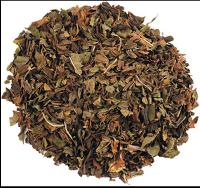
Mint (E), peppermint (E), horsemint (E), Pudina (H), Puthia (H):
This hardy perennial is famously fragrant. It is full of aromatic menthol, which 'wakes up' the senses and decongests the orifices of the head as well as calming and relaxing digestion.
Digestion Nervous digestion, flatulence, bloating, IBS, ulcers, nausea, and anorexia. Specific for pitta inflammation and irritation causing gastritis and enteritis. The aromatic essential oils cool the heat of pacaka pitta and regulate samana vayu. This can help to alleviate morning sickness, vomiting and spasms in the gastrointestinal tract. Colds Commonly used as a hot tea at a high dose to cause sweating in colds and flu. As mint moves upwards and outwards it is especially useful where ama blocks the pores and they need opening. It is useful where the lungs are congested with catarrh and constricted by spasm, causing wheezing or asthma. Nerves It normalises the flow of prana vayu all over the body. By moving upwards and outwards it spreads any congested vata blocked from whatever cause; ama, kapha, high vata or high pitta. The high levels of the space element (akas´a tattva) present within peppermint with its expansive nature moving upwards and outwards opens the mind and lifts the 'heaviness' of mental and emotional tension and constriction. It opens spaces and creates room for movement. Skin Peppermint water as an external spray is excellent for cooling and soothing skin inflammation, hot flushes and allergic itching. Gynaecology Often combined in formulas that help the flow of vata in the lower abdomen and ease menstrual congestion, pain and amenorrhoea.
This hardy perennial is famously fragrant. It is full of aromatic menthol, which 'wakes up' the senses and decongests the orifices of the head as well as calming and relaxing digestion.
Digestion Nervous digestion, flatulence, bloating, IBS, ulcers, nausea, and anorexia. Specific for pitta inflammation and irritation causing gastritis and enteritis. The aromatic essential oils cool the heat of pacaka pitta and regulate samana vayu. This can help to alleviate morning sickness, vomiting and spasms in the gastrointestinal tract. Colds Commonly used as a hot tea at a high dose to cause sweating in colds and flu. As mint moves upwards and outwards it is especially useful where ama blocks the pores and they need opening. It is useful where the lungs are congested with catarrh and constricted by spasm, causing wheezing or asthma. Nerves It normalises the flow of prana vayu all over the body. By moving upwards and outwards it spreads any congested vata blocked from whatever cause; ama, kapha, high vata or high pitta. The high levels of the space element (akas´a tattva) present within peppermint with its expansive nature moving upwards and outwards opens the mind and lifts the 'heaviness' of mental and emotional tension and constriction. It opens spaces and creates room for movement. Skin Peppermint water as an external spray is excellent for cooling and soothing skin inflammation, hot flushes and allergic itching. Gynaecology Often combined in formulas that help the flow of vata in the lower abdomen and ease menstrual congestion, pain and amenorrhoea.
62. Mustaka
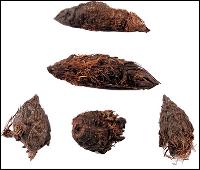
Nut grass (E), Motha (H):
This small aromatic tuber is commonly found next to rivers. It loves damp conditions and is very good at treating them. When considering using mustaka think of its aromatic, drying, antispasmodic qualities for gynaecology and digestion.
Digestion It regulates disturbed digestion, diarrhoea, colic, flatulence, borborygmus and bloating. Its antispasmodic effects treat pain in the intestines. It also has a specific use for Candida albicans and parasites when used at a high dose. When used at a low dose mustaka balances vata, especially s´amana and apana vayu, and stimulates digestion without aggravating pitta or creating any heat problems. Gynaecology One of the best herbs for the menstrual cycle as it regulates pitta and the flow of vata in the apanaksetra (the abode of apana vayu in the lower abdomen). This helps apana vayu to descend. Interestingly, this gynaecological activity is scientifically confirmed as mustaka also contains a phyto-oestrogen substance (?-sitosterol) (Williamson 2002; also see Mills & Bone [2000] for a very clear discussion of phyto-oestrogen activity), and so is relevant in all signs of high oestrogen; swollen breasts, pain, family history of breast cancer, short cycle. It has an affinity for the smooth muscle in the uterus and is a specific for PMS with bloating, pain, irritability, depression and a delayed onset. Its effect on rasa dhatu is also considered to be beneficial for purifying and nourishing breast milk. Liver As one of the main digestive stimulants for pitta it also has a special affinity for the liver and ran˜ jaka pitta. Its stimulating effect on the liver may help with the release of bile, metabolism of hormones, haemoglobin and fats. Its cooling effect on rakta dhatu can be of use in inflammatory skin problems such as eczema and pruritus. Fever It directly treats all the causes of fever; low agni, ama and excess pitta in the rasa dhatu. Its diaphoretic effect can be very useful for clearing ama and excess heat from the plasma and blood while also rectifying the digestive fire.
This small aromatic tuber is commonly found next to rivers. It loves damp conditions and is very good at treating them. When considering using mustaka think of its aromatic, drying, antispasmodic qualities for gynaecology and digestion.
Digestion It regulates disturbed digestion, diarrhoea, colic, flatulence, borborygmus and bloating. Its antispasmodic effects treat pain in the intestines. It also has a specific use for Candida albicans and parasites when used at a high dose. When used at a low dose mustaka balances vata, especially s´amana and apana vayu, and stimulates digestion without aggravating pitta or creating any heat problems. Gynaecology One of the best herbs for the menstrual cycle as it regulates pitta and the flow of vata in the apanaksetra (the abode of apana vayu in the lower abdomen). This helps apana vayu to descend. Interestingly, this gynaecological activity is scientifically confirmed as mustaka also contains a phyto-oestrogen substance (?-sitosterol) (Williamson 2002; also see Mills & Bone [2000] for a very clear discussion of phyto-oestrogen activity), and so is relevant in all signs of high oestrogen; swollen breasts, pain, family history of breast cancer, short cycle. It has an affinity for the smooth muscle in the uterus and is a specific for PMS with bloating, pain, irritability, depression and a delayed onset. Its effect on rasa dhatu is also considered to be beneficial for purifying and nourishing breast milk. Liver As one of the main digestive stimulants for pitta it also has a special affinity for the liver and ran˜ jaka pitta. Its stimulating effect on the liver may help with the release of bile, metabolism of hormones, haemoglobin and fats. Its cooling effect on rakta dhatu can be of use in inflammatory skin problems such as eczema and pruritus. Fever It directly treats all the causes of fever; low agni, ama and excess pitta in the rasa dhatu. Its diaphoretic effect can be very useful for clearing ama and excess heat from the plasma and blood while also rectifying the digestive fire.
63. Mustard Seed
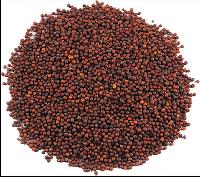
Mustard seed (E):
These little black or brown seeds have a warming and stimulating effect on the digestion and lungs. A wonderful home remedy for nipping the onset of a cold in the bud.
Digestion Mustard seed clears accumulations of food caused by low agni, high kapha and ama. It warms the digestive system, stimulates agni and clears sluggish congestion due to excess intestinal mucus. It is also used to kill worms. Lungs It is a great expectorant; clears white, sticky phlegm from the respiratory tract due to aggravated avalambaka kapha. Mustard seeds are beneficial in kapha-vata breathing problems—asthma, bronchitis, pneumonia. Also useful in colds where a mustard 'plaster' on the upper chest and throat can clear an imminent cold within a few hours (do not apply directly to the skin, place the poultice on a gauze first to prevent blistering) (Tierra 1992). Joints Useful in arthritis caused by a cold, wet, damp environment and lifestyle. Clears ama and regulates vata. Can prevent pain and swelling. Commonly used as a massage oil for constitutional kapha conditions.
These little black or brown seeds have a warming and stimulating effect on the digestion and lungs. A wonderful home remedy for nipping the onset of a cold in the bud.
Digestion Mustard seed clears accumulations of food caused by low agni, high kapha and ama. It warms the digestive system, stimulates agni and clears sluggish congestion due to excess intestinal mucus. It is also used to kill worms. Lungs It is a great expectorant; clears white, sticky phlegm from the respiratory tract due to aggravated avalambaka kapha. Mustard seeds are beneficial in kapha-vata breathing problems—asthma, bronchitis, pneumonia. Also useful in colds where a mustard 'plaster' on the upper chest and throat can clear an imminent cold within a few hours (do not apply directly to the skin, place the poultice on a gauze first to prevent blistering) (Tierra 1992). Joints Useful in arthritis caused by a cold, wet, damp environment and lifestyle. Clears ama and regulates vata. Can prevent pain and swelling. Commonly used as a massage oil for constitutional kapha conditions.
64. Myrrh

Myrrh (E), Bdellium gum (E), Bol (H):
Myrrh is extracted as a resin from the trunk of this thorny desert shrub. Its main feature is an affinity for the blood, heart and female reproductive systems but it is also a great antibacterial.
Heart Congestive heart disorders, hypercholesterol, atherosclerosis. As with all oleo-resins, it 'scrapes' cholesterol out of the body Lymph Lymphatic congestion, inflammation, lymphoedema; all fluid congestion and swellings in the body. It is used as a gargle for sore throats and spongy, bleeding gums. Gynaecology Endometriosis, fibroids, painful periods with clots, high pitta–kapha in apanaksetra, inflammation and congestion in the lower abdomen. Myrrh vigorously moves blood and 'breaks' stagnant pools of blood. Also used in amenorrhoea to stimulate blood flow. Pain All neuralgia around the body. Use externally to repair traumas, bruises and broken bones. Myrrh is a specific for treating arthritis and joint inflammation when s´lesaka kapha is causing swelling and degeneration of the joints. Mucous membranes Myrrh is the No.1 herb for mouth ulcers and cold sores. Its ability to increase white blood cell count is reflected in its popular use as a herbal antibiotic and antifungal effective against Escherichia coli, Candida albicans and Staphylococcus aureus. It helps to heal ulcerated intestinal surfaces.
Myrrh is extracted as a resin from the trunk of this thorny desert shrub. Its main feature is an affinity for the blood, heart and female reproductive systems but it is also a great antibacterial.
Heart Congestive heart disorders, hypercholesterol, atherosclerosis. As with all oleo-resins, it 'scrapes' cholesterol out of the body Lymph Lymphatic congestion, inflammation, lymphoedema; all fluid congestion and swellings in the body. It is used as a gargle for sore throats and spongy, bleeding gums. Gynaecology Endometriosis, fibroids, painful periods with clots, high pitta–kapha in apanaksetra, inflammation and congestion in the lower abdomen. Myrrh vigorously moves blood and 'breaks' stagnant pools of blood. Also used in amenorrhoea to stimulate blood flow. Pain All neuralgia around the body. Use externally to repair traumas, bruises and broken bones. Myrrh is a specific for treating arthritis and joint inflammation when s´lesaka kapha is causing swelling and degeneration of the joints. Mucous membranes Myrrh is the No.1 herb for mouth ulcers and cold sores. Its ability to increase white blood cell count is reflected in its popular use as a herbal antibiotic and antifungal effective against Escherichia coli, Candida albicans and Staphylococcus aureus. It helps to heal ulcerated intestinal surfaces.
65. Neem
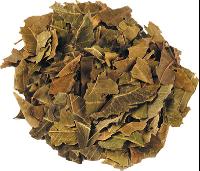
Neem (E), Margosa (E), Nim (H):
Myths abound concerning the healing properties of neem; its curative nature is said to have begun when a drop of nectar (amrta) fell on to it from the cup of immortality. Its bitter principle indicates its use in inflammations of the skin and digestive tract.
Skin Most effective in inflammatory skin conditions due to aggravated rakta and pitta with itching, oozing, burning and infection; eczema, psoriasis when active with Auspitz sign and bleeding, acne, urticaria, ringworm, scabies, lice. The oil is especially effective when applied externally for treating fungal and bacterial infections and as a mosquito repellant (use externally at 2–5% dilution). Its intense bitterness found in azadirachtin has renowned antibacterial and fungicidal activity. This property, plus its chlorophyll content, adds to its potential as a deodorant for putrid-smelling sweat and infected sores. Digestion Neem is used in intestinal inflammation and is specific for hyperacidity, ulcers, colitis and Crohn's disease with high pitta and kapha. It clears mucus and bleeding from the GIT. Useful in fissures, fistulas and haemorrhoids due to local congestion in the lower bowel. It clears the intestines of parasites and worms. Neem leaf is very usefu in chronic intestinal dysbiosis such as with Candida albicans, protozoal infections and bacterial infestation. Lungs The bitter and dry qualities are very useful for clearing kapha and pitta accumulations from the respiratory passages. Metabolic Its affinity for medovahasrotas is utilised in diabetes mellitus to support the system and regulate blood sugar levels. It clears kapha accumulations from the pancreas and activates medasdhatu- agni; this rectifies the compromised fat and water metabolism so common in diabetes. Mouth Neem has a traditional usage for toothache, gingivitis and general oral hygiene; use an infusion of the leaves as a mouthwash. The young twigs are used as the Indian toothbrush. Fevers Useful in high fever from pitta and accumulations of ama; especially in the intermittent fevers of malaria-like diseases. Reproduction As with many bitter herbs it reduces s´ukra dhatu and lowers sperm count. It has an affinity for the uterus and can reduce any inflammatory disorders.
Myths abound concerning the healing properties of neem; its curative nature is said to have begun when a drop of nectar (amrta) fell on to it from the cup of immortality. Its bitter principle indicates its use in inflammations of the skin and digestive tract.
Skin Most effective in inflammatory skin conditions due to aggravated rakta and pitta with itching, oozing, burning and infection; eczema, psoriasis when active with Auspitz sign and bleeding, acne, urticaria, ringworm, scabies, lice. The oil is especially effective when applied externally for treating fungal and bacterial infections and as a mosquito repellant (use externally at 2–5% dilution). Its intense bitterness found in azadirachtin has renowned antibacterial and fungicidal activity. This property, plus its chlorophyll content, adds to its potential as a deodorant for putrid-smelling sweat and infected sores. Digestion Neem is used in intestinal inflammation and is specific for hyperacidity, ulcers, colitis and Crohn's disease with high pitta and kapha. It clears mucus and bleeding from the GIT. Useful in fissures, fistulas and haemorrhoids due to local congestion in the lower bowel. It clears the intestines of parasites and worms. Neem leaf is very usefu in chronic intestinal dysbiosis such as with Candida albicans, protozoal infections and bacterial infestation. Lungs The bitter and dry qualities are very useful for clearing kapha and pitta accumulations from the respiratory passages. Metabolic Its affinity for medovahasrotas is utilised in diabetes mellitus to support the system and regulate blood sugar levels. It clears kapha accumulations from the pancreas and activates medasdhatu- agni; this rectifies the compromised fat and water metabolism so common in diabetes. Mouth Neem has a traditional usage for toothache, gingivitis and general oral hygiene; use an infusion of the leaves as a mouthwash. The young twigs are used as the Indian toothbrush. Fevers Useful in high fever from pitta and accumulations of ama; especially in the intermittent fevers of malaria-like diseases. Reproduction As with many bitter herbs it reduces s´ukra dhatu and lowers sperm count. It has an affinity for the uterus and can reduce any inflammatory disorders.
66. Nutmeg
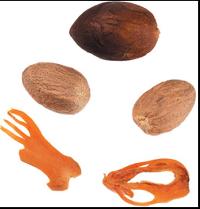
Nutmeg (E), Jaiphal (H):
Jatiphala means 'caste fruit' and Mada-s´aun.d. a means 'intoxicating fruit'. Its aromatic quality gives nutmeg its wonderful sedative properties that deeply relax the whole nervous system. It also has potent aphrodisiac qualities.
Nerves Insomnia, agitated mind and lack of concentration. When there is excitation and high vata in the mind it draws the expansive nature of vata inwards. Its heavy nature can 'dull' the mind; therefore use for short periods of time at a low dose. Use 1?8 teaspoon in warm milk (almond or cow) before bed to aid sleep and stops restless leg syndrome. Useful for transient insomnia where the sleep is interrupted. Also helps to relax the muscles and prevent pain associated with angina, fibromyalgia and arthritis. Digestion Nutmeg helps absorption in the small intestine and purisavahasrotas. Its astringency draws nutrients into the bloodstream. It can help to stop diarrhoea and dysentery with excess vata and kapha. It calms intestinal spasms, pain, gas and bloating. It is a useful anthelmintic. Reproduction Used in male infertility and premature ejaculation. Another 'clever' herb with dual action, it both stimulates erectile function and astringes ejaculation. It is one of the primary aphrodisiacs used to tonify s´ukra dhatu. It also reduces excessive urination from high vata and kapha and is used in prostatic disease and incontinence. Also useful in female infertility when there is disruption of the menstrual cycle with pain. Lungs Its hot and penetrating properties can help to clear excess avalambaka kapha from the lungs.
Jatiphala means 'caste fruit' and Mada-s´aun.d. a means 'intoxicating fruit'. Its aromatic quality gives nutmeg its wonderful sedative properties that deeply relax the whole nervous system. It also has potent aphrodisiac qualities.
Nerves Insomnia, agitated mind and lack of concentration. When there is excitation and high vata in the mind it draws the expansive nature of vata inwards. Its heavy nature can 'dull' the mind; therefore use for short periods of time at a low dose. Use 1?8 teaspoon in warm milk (almond or cow) before bed to aid sleep and stops restless leg syndrome. Useful for transient insomnia where the sleep is interrupted. Also helps to relax the muscles and prevent pain associated with angina, fibromyalgia and arthritis. Digestion Nutmeg helps absorption in the small intestine and purisavahasrotas. Its astringency draws nutrients into the bloodstream. It can help to stop diarrhoea and dysentery with excess vata and kapha. It calms intestinal spasms, pain, gas and bloating. It is a useful anthelmintic. Reproduction Used in male infertility and premature ejaculation. Another 'clever' herb with dual action, it both stimulates erectile function and astringes ejaculation. It is one of the primary aphrodisiacs used to tonify s´ukra dhatu. It also reduces excessive urination from high vata and kapha and is used in prostatic disease and incontinence. Also useful in female infertility when there is disruption of the menstrual cycle with pain. Lungs Its hot and penetrating properties can help to clear excess avalambaka kapha from the lungs.
67. Pepper
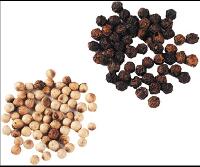
Black pepper (E), Kalimirch (H):
Named after one of the names of the sun, mar?-ca, it has the same qualities as this macrocosmic source of heat and light. It is warming, drying and stimulating to the circulatory, digestive and respiratory systems.
Digestion Useful for low appetite, sluggish digestion, abdominal pain, toxins or ama and borborygmus. Black pepper's hot and penetrating qualities are a great stimulant to agni as they help to increase enzymatic secretions. This helps to enhance absorption of nutrients and literally 'burn' ama. Its affinity for purisavahasrotas coupled with its anthelmintic qualities helps to remove worms. It can be used as part of the physical treatment of anorexia to stimulate hunger and interest in food. As it contains chromium, a component of glucose tolerance factor, black pepper is a useful part of many diabetes treatments; it normalises medas dhatu and prevents ama overflowing into the pancreas and urine. Lungs Specific for cold, wet, damp, kapha conditions in the pranavahasrotas with white, sticky mucus and a productive cough; asthma, bronchitis, pneumonia and sore throats. Black pepper infused oil or ghee, applied into the nose, can be a wonderful decongestant to the sinuses blocked with kapha or ama. Fevers It can help to 'cook' the pathogens and then induce a sweat to release the misplaced agni that has moved from the stomach to the plasma tissue. It clears ama from rasa dhatu and normalises the digestive fire in the stomach. Used as part of treatment in intermittent fevers such as malaria when it is often combined with bitter and cooling herbs. Circulation Pepper has the ability to stimulate microcirculation in the capillaries. This can be useful in cirrhosis, hepatitis and skin diseases with signs of stagnant blood; red or purple patches and chronic lesions. This can also be of benefit in cold congestion in the uterus and apanaksetra with dysmenorrhoea and amenorrhoea. External application of the essential oil can help to relieve neuralgic and arthritic pain with cold swellings.
Named after one of the names of the sun, mar?-ca, it has the same qualities as this macrocosmic source of heat and light. It is warming, drying and stimulating to the circulatory, digestive and respiratory systems.
Digestion Useful for low appetite, sluggish digestion, abdominal pain, toxins or ama and borborygmus. Black pepper's hot and penetrating qualities are a great stimulant to agni as they help to increase enzymatic secretions. This helps to enhance absorption of nutrients and literally 'burn' ama. Its affinity for purisavahasrotas coupled with its anthelmintic qualities helps to remove worms. It can be used as part of the physical treatment of anorexia to stimulate hunger and interest in food. As it contains chromium, a component of glucose tolerance factor, black pepper is a useful part of many diabetes treatments; it normalises medas dhatu and prevents ama overflowing into the pancreas and urine. Lungs Specific for cold, wet, damp, kapha conditions in the pranavahasrotas with white, sticky mucus and a productive cough; asthma, bronchitis, pneumonia and sore throats. Black pepper infused oil or ghee, applied into the nose, can be a wonderful decongestant to the sinuses blocked with kapha or ama. Fevers It can help to 'cook' the pathogens and then induce a sweat to release the misplaced agni that has moved from the stomach to the plasma tissue. It clears ama from rasa dhatu and normalises the digestive fire in the stomach. Used as part of treatment in intermittent fevers such as malaria when it is often combined with bitter and cooling herbs. Circulation Pepper has the ability to stimulate microcirculation in the capillaries. This can be useful in cirrhosis, hepatitis and skin diseases with signs of stagnant blood; red or purple patches and chronic lesions. This can also be of benefit in cold congestion in the uterus and apanaksetra with dysmenorrhoea and amenorrhoea. External application of the essential oil can help to relieve neuralgic and arthritic pain with cold swellings.
68. Pippali
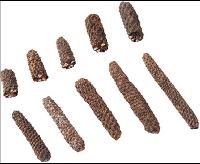
Long pepper (E), Pipal (H), Pimpli (H):
This small shrub grows all over the tropical forests of India. It is a fine rejuvenative to the respiratory system; its sweet post-digestive effect is very nourishing to the deeper reproductive tissues of the body.
Lungs Primarily used for cold, wet and 'mucousy' conditions of the lungs. It is a rejuvenative for the lungs, pranavahasrotas and avalambaka kapha. It encourages vasodilation and therefore increases circulation, specifically to the lungs. Used with honey in asthma, bronchitis, pneumonia and compromised immunity in the respiratory system to reduce kapha. It is also used to treat mild fever by removing the ama from rasa dhatu and alleviating the concurrent aches in the muscles and joints. Digestion Used to stimulate agni and clear weak digestion with symptoms of nausea, slow digestion, flatulence with a cold and painful abdomen. In malabsorption it can increase assimilation of nutrients. Clinical studies show that that piperine increases the absorption of curcumin in turmeric root (used at 1:10). Its anthelmintic qualities are used as part of a formula to kill worms, amoebas and parasites. It helps to treat diarrhoea from cold symptoms and constipation (vibandha) from stagnant apana vayu. Also used in diabetes as it reduces any excess of and rejuvenates the medas dhatu (Koul & Kapil 1993, Tillotson 2001). Reproduction Its sweet postdigestive effect points to its ability to tonify the s´ukra dhatu and reproductive tissue, which is useful in infertility, impotence and premature ejaculation. It is one of the only heating and penetrating substances to do this as heating substances usually consume s´ukra dhatu. Circulation Its pungency and sweetness invigorate blood and nourish rakta. By enhancing the digestive fire in the tissues it is a rasayana to rasa and rakta dhatu as it helps to assimiliate more nutrients for building the plasma and the blood. It can also help to penetrate the cold pain of sciatica. Liver It has a hepatoprotective effect that may benefit fibrosis. Nerves Its ability to nourish majja dhatu, due to its sweet vipaka, helps in vata disorders and also to nourish the brain.
This small shrub grows all over the tropical forests of India. It is a fine rejuvenative to the respiratory system; its sweet post-digestive effect is very nourishing to the deeper reproductive tissues of the body.
Lungs Primarily used for cold, wet and 'mucousy' conditions of the lungs. It is a rejuvenative for the lungs, pranavahasrotas and avalambaka kapha. It encourages vasodilation and therefore increases circulation, specifically to the lungs. Used with honey in asthma, bronchitis, pneumonia and compromised immunity in the respiratory system to reduce kapha. It is also used to treat mild fever by removing the ama from rasa dhatu and alleviating the concurrent aches in the muscles and joints. Digestion Used to stimulate agni and clear weak digestion with symptoms of nausea, slow digestion, flatulence with a cold and painful abdomen. In malabsorption it can increase assimilation of nutrients. Clinical studies show that that piperine increases the absorption of curcumin in turmeric root (used at 1:10). Its anthelmintic qualities are used as part of a formula to kill worms, amoebas and parasites. It helps to treat diarrhoea from cold symptoms and constipation (vibandha) from stagnant apana vayu. Also used in diabetes as it reduces any excess of and rejuvenates the medas dhatu (Koul & Kapil 1993, Tillotson 2001). Reproduction Its sweet postdigestive effect points to its ability to tonify the s´ukra dhatu and reproductive tissue, which is useful in infertility, impotence and premature ejaculation. It is one of the only heating and penetrating substances to do this as heating substances usually consume s´ukra dhatu. Circulation Its pungency and sweetness invigorate blood and nourish rakta. By enhancing the digestive fire in the tissues it is a rasayana to rasa and rakta dhatu as it helps to assimiliate more nutrients for building the plasma and the blood. It can also help to penetrate the cold pain of sciatica. Liver It has a hepatoprotective effect that may benefit fibrosis. Nerves Its ability to nourish majja dhatu, due to its sweet vipaka, helps in vata disorders and also to nourish the brain.
69. Pit Shirisha
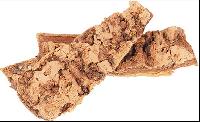
Shirish (H), Siris (H):
The bark of this tree is renowned for strengthening the lungs and clearing mucus accumulations from the lymph and lungs. It is a potent antiallergenic herb.
Lungs Its affinity for pranavahasrotas benefits asthma of the vata–kapha variety—a wet, damp cough with wheezing, worse in the morning and evening. Its ´sirovirecana action helps in reducing allergic reactions in the head such as allergic rhinitis, hayfever and asthma in atopic individuals. Human clinical trials attest to its efficacy in early-onset asthma. Skin Its antiallergic, anti-inflammatory and pitta-reducing effect is beneficial in atopic and allergic conditions; eczema, urticaria, dermatitis. This is by virtue of its affinity for rasa and rakta dhatu. It is a specific for itching and suppurating inflammations. Lymph It helps to reduce swellings in the lymphatic system and clears kapha from the plasma tissue.
The bark of this tree is renowned for strengthening the lungs and clearing mucus accumulations from the lymph and lungs. It is a potent antiallergenic herb.
Lungs Its affinity for pranavahasrotas benefits asthma of the vata–kapha variety—a wet, damp cough with wheezing, worse in the morning and evening. Its ´sirovirecana action helps in reducing allergic reactions in the head such as allergic rhinitis, hayfever and asthma in atopic individuals. Human clinical trials attest to its efficacy in early-onset asthma. Skin Its antiallergic, anti-inflammatory and pitta-reducing effect is beneficial in atopic and allergic conditions; eczema, urticaria, dermatitis. This is by virtue of its affinity for rasa and rakta dhatu. It is a specific for itching and suppurating inflammations. Lymph It helps to reduce swellings in the lymphatic system and clears kapha from the plasma tissue.
70. Pomegranate
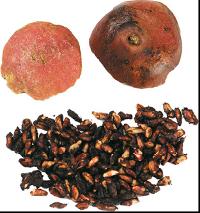
Pomegranate (E), Anar (fruit) (H), Anardana (seeds) (H):
This beautiful red fruit is famed for its taste as well as being a fertility symbol. It specifically balances an acidic digestion, nourishes the heart and balances levels of oestrogen.
Digestion The sweet juice of the fruit is a wonderful cooling drink for soothing an inflamed stomach and intestines. It is a specific for hyperacidity and the resulting nausea. Its mild astringency helps to slow the movement of vata and alleviates any excess pitta. The rind is a fine astringent that will bind a loose bowel very quickly. It is a common folk remedy for dysentery with bleeding and mucus. It also kills parasites; it is a specific for tapeworms, pinworms and roundworms. The dry, roasted seeds are a great benefit to those with an excessive appetite, tiksnagni, as they help to balance the excess pitta (Lad 1998). Heart As a wonderful cordial herb it strengthens the heart. Its affinity for the blood helps to nourish rakta dhatu. Its sweet and astringent qualities are beneficial in bleeding anywhere in the circulatory system. Reproduction Pomegranates are a well-known aphrodisiac. They benefit the semen (s´ukrala) via the plasma or rasa dhatu. The decoction of the rind can be used as a douche in leucorrhoea. There is recent interest in using pomegranates to treat prostate problems including BPH and prostatic cancer. Menopause Pomegranates are useful for maintaining healthy levels of oestrogen as they contain small amounts of estrone. Eat the fresh fruit, juice or seeds regularly during menopause. The sweet flavour can help to cool sensations of burning and flushing. Nerves The beneficial effect of the fruit on majja dhatu helps to nourish the brain and nervous system.
This beautiful red fruit is famed for its taste as well as being a fertility symbol. It specifically balances an acidic digestion, nourishes the heart and balances levels of oestrogen.
Digestion The sweet juice of the fruit is a wonderful cooling drink for soothing an inflamed stomach and intestines. It is a specific for hyperacidity and the resulting nausea. Its mild astringency helps to slow the movement of vata and alleviates any excess pitta. The rind is a fine astringent that will bind a loose bowel very quickly. It is a common folk remedy for dysentery with bleeding and mucus. It also kills parasites; it is a specific for tapeworms, pinworms and roundworms. The dry, roasted seeds are a great benefit to those with an excessive appetite, tiksnagni, as they help to balance the excess pitta (Lad 1998). Heart As a wonderful cordial herb it strengthens the heart. Its affinity for the blood helps to nourish rakta dhatu. Its sweet and astringent qualities are beneficial in bleeding anywhere in the circulatory system. Reproduction Pomegranates are a well-known aphrodisiac. They benefit the semen (s´ukrala) via the plasma or rasa dhatu. The decoction of the rind can be used as a douche in leucorrhoea. There is recent interest in using pomegranates to treat prostate problems including BPH and prostatic cancer. Menopause Pomegranates are useful for maintaining healthy levels of oestrogen as they contain small amounts of estrone. Eat the fresh fruit, juice or seeds regularly during menopause. The sweet flavour can help to cool sensations of burning and flushing. Nerves The beneficial effect of the fruit on majja dhatu helps to nourish the brain and nervous system.