Lal Bahadur Shastri
Lal Bahadur Shastri was the Second Prime Minister of the Republic of India.
21. Domestic policies
Shastri retained many members of Nehrus Council of Ministers. T. T. Krishnamachari was retained as the Finance Minister of India, as was Defence Minister Yashwantrao Chavan. He appointed Swaran Singh to succeed him as External Affairs Minister. He also appointed Indira Gandhi, daughter of Jawaharlal Nehru and former Congress President, as the Minister of Information and Broadcasting. Gulzarilal Nanda continued as the Minister of Home Affairs.
Shastris tenure witnessed the Madras anti Hindi agitation of 1965. The government of India had for a long time made an effort to establish Hindi as the sole national language of India. This was resisted by the non Hindi speaking states particularly Madras State. To calm the situation, Shastri gave assurances that English would continue to be used as the official language as long the non Hindi speaking states wanted. The riots subsided after Shastris assurance, as did the student agitation.
22. Economic policies
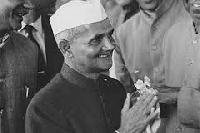
Shastri continued Nehrus socialist economic policies with central planning. He promoted the White Revolution a national campaign to increase the production and supply of milk by supporting the Amul milk co operative of Anand, Gujarat and creating the National Dairy Development Board. Shri Lal Bahadur Shastri, Prime Minister of India, visited Anand on 31 October 1964 for inauguration of the Cattle Feed Factory of Amul at Kanjari. As he was keenly interested in knowing the success of this co operative, spent a whole night with farmers in a village, even had dinner with a farmer discusses his wish to Mr Verghese Kurien, then the General Manager of Kaira District Co operative Milk Producers Union Ltd (Amul) to replicate this model to other parts of the country for improving the socio economic conditions of farmers. As a result of this visit, the National Dairy Development Board (NDDB) was established at Anand in 1965.
While speaking on the chronic food shortages across the country, Shastri urged people to voluntarily give up one meal so that the saved food could be distributed to the affected populace. He himself motivate the countrymen to maximize the cultivation of food grains by plough the lawn in his official residence in New Delhi.Shastri hated the idea of going around with a begging bowl. So he hit upon a novel idea. He went on air to appeal to his countrymen to skip a meal a week. The response was overwhelming. Even restaurants and eateries downed the shutters on Monday evenings. Many parts of the country observe the Shastri Vrat. First he implement the system in his own family before appealing to the country men.During the 22 day war with Pakistan in 1965, On October 19, 1965, Shastri gave the seminal
23. Foreign policies

Shastri continued Nehrus policy of non alignment but also built closer relations with the Soviet Union. In the aftermath of the Sino Indian War of 1962 and the formation of military ties between the Chinese Peoples Republic and Pakistan, Shastris government decided to expand the defence budget of Indias armed forces.In 1964, Shastri signed an accord with the Sri Lankan Prime minister Sirimavo Bandaranaike regarding the status of Indian Tamils in the then Ceylon.This agreement is also known as the Srimavo Shastri Pact or the Bandaranaike Shastri pact.Under the terms of this agreement, 600,000 Indian Tamils were to be repatriated, while 375,000 were to be granted Sri Lankan citizenship. This settlement was to be done by 31 October 1981. However, after Shastris death, by 1981, India had taken only 300,000 Tamils as repatriates, while Sri Lanka had granted citizenship to only 185,000 citizens (plus another 62,000 born after 1964). Later, India declined to consider any further applications for citizenship, stating that the 1964 agreement had lapsed.
In December 1965 Lal Bahadur Shastri made an official visit with his Family to Rangoon, Burma and re established a cordial relation with the countrys Military government of General Ne Win. Indias relationship with Burma stained after the 1962 Military coup followed by Lakhs of Indian Family most of them are Tamils and Bengalis repatriate to India from 1964.The central government in New Delhi monitored the overall process of repatriation and arranged for identification and then transportation of the Indian returnees from Burma back into India, it fell under the responsibilities of local governments to provide adequate facilities to shelter the repatriates upon disembarkation on Indian soil. Particularly in the Madras State the Chief Minister during that time Mr. Minjur K. Bhaktavatsalam shown great care in rehabilitation of the returnees.
24. War with Pakistan

Shastris greatest moment came when he led India in the 1965 Indo Pak War.Laying claim to half the Kutch peninsula, the Pakistani army skirmished with Indian forces in August, 1965. In his report to the Lok Sabha on the confrontation in Kutch, Shastri stated.In the utilization of our limited resources, we have always given primacy to plans and projects for economic development. It would, therefore, be obvious for anyone who is prepared to look at things objectively that India can have no possible interest in provoking border incidents or in building up an atmosphere of strife... In these circumstances, the duty of Government is quite clear and this duty will be discharged fully and effectively... We would prefer to live in poverty for as long as necessary but we shall not allow our freedom to be subverted.
Under a scheme proposed in June 1965 by British Prime Minister Harold Wilson, Pakistan obtained 10%, in place of their original claim of 50% of the territory. But Pakistans aggressive intentions were also focused on Kashmir. When armed infiltrators from Pakistan began entering the State of Jammu and Kashmir, Shastri made it clear to Pakistan that force would be met with force. In September 1965, major incursions of militants and Pakistani soldiers began, hoping not only to break down the government but incite a sympathetic revolt. The revolt did not happen, and India sent its forces across the Ceasefire Line (now Line of Control) and threatened Pakistan by crossing the International Border near Lahore as war broke out on a general scale. Massive tank battles occurred in the Punjab, and while the Pakistani forces made some gains, Indian forces captured the key post at Haji Pir, in Kashmir, and brought the Pakistani city of Lahore under artillery and mortar fire.
On 17 September 1965, while the Indo Pak war was on, India received a letter from China alleging that the Indian army had set up army equipment in Chinese territory, and India would face Chinas wrath, unless the equipment was pulled down. In spite of the threat of aggression from China, Shastri declared Chinas allegation is untrue. If China attacks India it is our firm resolve to fight for our freedom. The might of China will not deter us from defending our territorial integrity. The Chinese did not respond, but the Indo Pak war resulted in some 34,000 casualties on each side and significant loss of material.The Indo Pak war ended on 23 September 1965 with a United Nations mandated ceasefire. By that time, India had inflicted a crushing defeat on Pakistan. In a broadcast to the nation on the day the of ceasefire, Shastri stated.While the conflict between the armed forces of the two countries has come to an end, the more important thing for the United Nations and all those who stand for peace is to bring to an end the deeper conflict.... How can this be brought about? In our view, the only answer lies in peaceful coexistence. India has stood for the principle of coexistence and championed it all over the world. Peaceful coexistence is possible among nations no matter how deep the differences between them, how far apart they are in their political and economic systems, no matter how intense the issues that divide them.
During his tenure as Prime Minister, Shastri visited many countries including Russia, Yugoslavia, England, Canada, Nepal, Egypt and Burma.[8] Incidentally en route to the Non Alliance Conference in Cairo he met the Pakistan President Ayub Khan at Karachi Airport during fuel refilling in 1964. After the declaration of ceasefire with Pakistan in 1965, Shastri and Pakistani President Muhammad Ayub Khan attended a summit in Tashkent (former USSR, now in modern Uzbekistan), organized by Alexei Kosygin. On 10 January 1966, Shastri and Khan signed the Tashkent Declaration.
25. Memorials
Shastri was known for his honesty and humility throughout his life. He was the first person to be posthumously awarded the Bharat Ratna, and a memorial Vijay Ghat was built for him in Delhi.Several educational institutes, Lal Bahadur Shastri National Academy of Administration (Mussorie, Uttarakhand) is after his name.Lal Bahadur Shastri Institute of Management was established in Delhi by the Lal Bahadur Shastri Educational Trust in 1995 as is one of the top business schools in India.The Shastri Indo Canadian Institute was named after Shastri due to his role in promoting scholarly activity between India and Canada.Lal Bhadur Shastri Memorial run by Lal Bahadur Shastri National Memorial Trust, is situated next to 10 Janpath his residence as Prime Minister, at 1, Motilal Nehru Place, New Delhi.
26. Freedoms Soldier

The struggle for freedom was intensifield all over the country in 1930. Mahatma Gandhi started the Salt Satyagraha. Lal Bahadur took a leading role in it.At the age of seventeen Lal Bahadur had participated in a procession against the British Government. The government had arrested him and then freed him. But this time it did not let him off easily. He had been calling on people not to pay land revenue and taxes to the government and the government had been keeping a wary eye on him. Now he was sent to prison for two and a half years.From this time onwards prison became his second home. He was sent to prison seven times and was forced to spend nine long years in various prisons on different occasions.His going to prison was a blessing in disguise. He had time to read a number of good books. He became familiar with the works of western philosophers, revolutionaries and social reformers. He translated the autobiography of Madam Curie (a French scientist who discovered radium) into Hindi.Lal Bahadurs virtues shone even in the prison. He was a ideal prisoner. He was a model to others in discipline and restraint. Many political prisoners used to quarrel among themselves for small things. They used to cringe for small favors before the officials of the prison. But Lal Bahadur used to give up his comforts for others.
27. The Responsibility of Freedom

Later, in 1947, Lal Bahadur became the Minister of Police and Transport in Pants Ministry. He took many steps to bring discipline into the administration. As Transport Minister he subjected government buses to discipline. He was the first to appoint women conductors. Usually the minister in charge of the Police Department will not remain popular for long. But Lal Bahadur Shastri never allowed the police to resort to lathi charge and firing. He ordered that using jets of water instead of lathis should disperse unruly crowds. Though there were many strikes in Uttar Pradesh when he was in office, there was not a single occasion when people shouted slogans against him.
Lal Bahadur was a lover of cricket. Once he was watching a match at Kanpur. Trouble broke out among the spectators. The Police and young men came to blows. Since Shastriji was on the spot thesituation did not go out of control. The young men demanded that the red turbans (thepolice) should not be found on the cricket ground and Lal Bahadur agreed. But the police were there the next day. The young men became angry with Shastriji and protested. Lal Bahadur laughed and said, I fulfilled my promise to you faithfully. You did not want red turbans to be here. You see the police are now wearing khaki turbans. The spectators laughed and dropped the matter.
28. China Cannot Frighten Us

Just at this time another danger threatened India. China sent a letter, which said, The Indian army has set up army equipment in Chinese territory. India should pull down this equipment. Otherwise it will have to face the wrath of China.At that moment India was fighting against the Pakistani army equipped with the latest weapons supplied in plety by the United States of America. And, at this very moment how was India to resist China.Chinas allegations were a bundle of lies. If India removed the military equipment she would be admitting that Chinas charges were true. Also, that would mean India was afraid of China.Even the big nations waited breathlessly to see what Lal Bahadur would say and what India would do.Lal Bahadur did not take long to give a reply. The letter from China was received on the morning of 17th September 1965. He made a statement in the Parliament the same afternoon. He declared: Chinas allegation is untrue. If China attacks India it is our firm resolve to fight for our freedom. The might of China will not deter us from defending our territorial integrity.
China kept quiet.Indias soldiers had no fear of death and fought most splendidly and heroically. The army and the air force functioned like the two arms of a single body. The invaders were beaten. The Pakistani army could not stand against the Indian army. It was then that, for the first time, the world came to realize the supremacy of the Indian army.
29. Force will be met with force

Even before the ink with which they had signed the Kutch agreement dried up, Pakisthan raised its hood to strike again. Pakistani soldiers entered Kashmir in disguise. In September 1965 there was a large scale invasion of the territory by Pakistani soldiers in the Chhamb area. War broke out all along the Cease fire Line on the Kashmir border.The enemies who had managed to enter Kashmir were cunning and mischievous. Pakistan also tried to incite Indian Muslims. The Pakisthan army was engaged in forcibly occupying areas, which belonged to India. There was the danger of the fighting spreading to the eastern border also. In addition to this, there was the threat posed by the Chinese on the northern borders of India. Lal Bahadur Shastri faced all these problems with a will of iron. It was at this time that the country understood the greatness of Lal Bahadur Shastri. He decided that was the time to teach Pakistan a lesson. He gave full freedom to the Commander of the Army. Go forward and strike was Shastrijis command to the generals.
Addressing the nation on 13th August 1965 Shastriji referred to Pakistans threats and said, Force will be met with force. Two days later, during the celebration of Independence day, he declared from the ramparts of the Red Fort: It does not matter if we are destroyed. We will fight to the last to maintain the high honor of the Indian nation and its flag.
30. Death
Lal Bahadur Shastri, who had earlier suffered two heart attacks, died of the third cardiac arrest on 11 January, 1966. He is the only Indian Prime Minister, to have died in office, overseas. Lal Bahadur Shastri was the first person to be posthumously awarded the Bharat Ratna, (Indias highest civilian award).