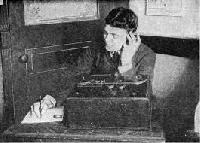
Guglielmo Marconi
Guglielmo Marconi 1st Marquis of Marconi was an Italian inventor and electrical engineer,
11. Contributions and Achievements

Marconi was convinced that communication among people was possible via wireless radio signaling. He started conducting experiment in 1895 at his fathers home in Pontecchio, where he was soon able to send signals over one and a half miles. During this period, he also carried out simple experiments with reflectors around the aerial to concentrate the radiated electrical energy into a beam instead of spreading it in all directions.In 1896 Marconi traveled to England in order to get a patent for his apparatus. Later that year he was granted the worlds first patent for a system of wireless telegraphy. After successfully demonstrating the systems ability to transmit radio signals in London, on Salisbury Plain and across the Bristol Channel, he established the Wireless Telegraph & Signal Company Limited in July 1897. This company was renamed as Marconis Wireless Telegraph Company Limited in 1990.
In 1899 he established a wireless link between Britain and France across the English Channel. Further he established permanent wireless stations at The Needles, Isle of Wight, Bournemouth, and later at the Haven Hotel in Poole, Dorset. The following year he received his patent for tuned or systonic telegraphy.During December 1901 Marconi proved that wireless signals were unaffected by the curvature of the earth. He transmitted the first wireless signals across the Atlantic between Poldhu, Cornwall and St, Johns, New Foundland, a distance of 2100 miles.The next year he demonstrated daylight effect relative to wireless communication and also he patented his magnetic detector, which was the standard wireless receiver for many years. In December he successfully transmitted the first complete message to Poldhu from stations at Glace Bay, Nova Scotia and Cape Cod Massachusetts.In 1905 and 1912 Marconi patented his horizontal directional aerial and patented a timed spark system for generating continuous waves respectively.
12. Later Life
In 1914, he took the position of a Lieutenant in the Italian Army. Later he was promoted to Captain and in 1916 was appointed as a Commander in the Navy, receiving his Italian Military Medal in 1919 for his war service. He also used his systems for the workings of the military. During this time he continued with his experiments, establishing the worlds first microwave radiotelephone link in 1932, and later introducing the microwave beacon for ship navigation.Marconi died in Rome on 20 July 1937 following a series of heart attacks.
13. Marconis childhood

Guglielmo Marconi was born on 25th April 1874 in Bologna in Northern Italy.Marconis, father, Guiseppe, was a widower and wealthy Italian. His mother came from a Scottish and Irish family of brewers and distillers, and she ran away from home to marry him.Marconis mother loved to travel and the young Guglielmo accompanied her on many of her trips. As a result the young Marconi received private tuition, this gave him further insight into some of the fundamental concepts he would require later. He later attended a school in Florence, but found his work difficult. Nevertheless Marconi still managed to progress to the Technical Institute of Leghorn where he was more successful, and developed an interest in physics.Unfortunately Marconi left the Institute without any formal qualifications. This displeased his father, but despite this he returned home and continued to perform various scientific experiments.Marconis mother was very loyal to her son, and she arranged that one of their neighbours, a noted physicist named Professor Righi acted as an adviser. It was through this contact that Marconis interest became focused on the newly discovered radio or Hertzian Waves.
14. Marconis wireless experiments
With Marconis interest fired with ideas of Hertzian Waves. He started by repeating the experiments of Heinrich Hertz who had discovered their existence. These experiments used a spark in a transmitting circuit to induce a second but smaller spark in a receiving circuit placed a short distance away.Like Hertz he only managed to achieve ranges of a few metres. Later he managed to improve the distance over which the spark could be detected by using a device called a coherer in the receiver. A Frenchman named Edouard Branly was the first to observe the effect behind the coherer and this was later improved and popularised by Oliver Lodge in its use for detecting Hertzian wave transmissions.
15. Move

History shows that Guglielmo Marconi was not deterred by his rejection, but in order to be able to exploit his idea he moved to England with his mother in February 1896.On their arrival, Marconi and his mother were met by his cousin, Henry JamesonDavies. He was an engineer himself, and gave the young Marconi an introduction to A.A. Campbell Swinton, Scottish consulting electrical engineer who was interested in communications and had been following some of the experiments performed by Hertz. As a result he had some connections who were of use to Marconi, introducing him to William Preece the Chief Engineer of the Post Office. Preece was keenly interested in wireless forms of communications and had performed a number of wireless experiments himself.Following up on his new introduction, Marconi undertook a number of demonstrations. The first was set up on the rooftops of two buildings in London in July of that year. Communication was successfully made over a distance of a few hundred yards. This impressed all that were present, especially because there were buildings in the line of transmission, and wireless communication was still very new and a great novelty.
As a result of the success of the first demonstration a further test was requested on Salisbury Plain at the beginning of September. This time representatives from the War Office and the Admiralty were also present. In view of the additional observers, Marconi used parabolic reflectors at the transmitter and receiver to show the directional properties of the waves. This was important to show that secrecy could be maintained during transmissions. The use of this technology limited the range to only about two and a half kilometres. Further tests six months later used balloons to raise the height of more conventional antennas. This time a range of over seven kilometres was achieved.The next demonstration was made to the press. This was very successful, partly because of the novelty of being able to communicate electrically without any intervening wires. The effect was also enhanced by the showmanship used in the performance as both transmitter and receiver were housed in black boxes. As a result Marconi became an instant celebrity.Up until this time the new Hertzian or radio waves used by Marconi had not been put to any real use. Then in 1897 it was decided to test the new system and see if it could provide a reliable link across various stretches of water. If this were successful it would save on the installation of expensive submarine cables. In some of the first of these tests across the Bristol Channel, Marconis system proved to be very successful, further enhancing his image.
16. Marconi opens for business
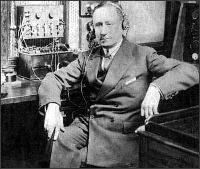
With the success of these tests interest in the possible uses of radio grew, and in July 1897 Marconi decided that he had to launch his own company. Named the Wireless Telegraph and Signal Company Limited its foundation allowed him to borrow further money to allow further tests and development to be performed. With financial backing behind him he continued his developments and tests.Little was still understood about Wireless or Hertzian waves and therefore further tests were needed. In late 1897 Marconi erected masts over 40 metres high outside the Needles Hotel on the Isle of Wight. From here he made transmissions which he received on a boat which steamed up and down the Solent to test reception over the sea. From this site he managed to achieve a range of over 30 kilometres and also confirmed that transmissions could be reliably made over water. As evidence of this anyone visiting the Needles today can see a plaque in the car park commemorating the site of these transmissions.
With these further increases in range it was decided to attempt to make the first international radio link by transmitting across the English Channel. To achieve this, masts were set up at South Foreland and at Wimereux near Boulogne and the first successful international wireless transmissions were made in 1899. In view of its importance this test received a large amount of press coverage, and was very successful. However it also enabled new discoveries to be made because the transmissions were picked up over 130 kilometres away in Chelmsford. This discovery was very significant because until this time it was only thought that transmissions could be made over line of sight paths.The same year brought another success for Marconi. He received his first order from the British Navy. Up until this time he had spent large sums of money on research, but had received very few orders. If his company was to survive, then he needed more orders of this nature.
17. Marconi prepares for the Atlantic
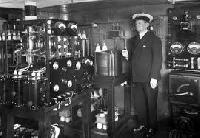
The first stage of his preparation for a transatlantic transmission was for Marconi to convince his fellow directors that this test, which would have enormous expense associated with it would be worthwhile. Marconi faced a tough battle to convince them, but eventually he succeeded in gaining their reluctant agreement for this massive project.To enable the long range radio communications to be established, it was essential to choose the correct sites to provide the best chance of success. Sites were selected either side of the Atlantic at Poldhu in Cornwall and Cape Cod in Massachusetts.The Poldhu station was the first to be set up. A massive antenna consisting of a ring of twenty masts over sixty metres high was erected. This supported a cone of wires that formed the actual antenna.
One of Marconis assistants, a man named Vyvyan expressed concern over the design of the antenna. His reservations were dismissed, but unfortunately he was proved to be right as the whole structure collapsed in a gale.The antenna at Cape Cod was of the same design, and even became distorted in a strong breeze. Later it suffered the same fate as the one the other side of the Atlantic. By a strange quirk of fate one of the masts narrowly missed Marconis assistant Vyvyan.
18. Flemings transmitter
In order to meet the requirements for a transatlantic transmission, a totally new form of transmitter would be required. One with a far greater power generation capacity was needed.The task of designing and developing this new radio transmitter fell to Ambrose Fleming. He was Professor at University College London and a consultant to Marconis company.In Flemings transmitter an alternator charges the capacitor C1 through a circuit that is resonant at the alternator frequency. Sparkgap S1 discharges to create a higher frequency signal and the step up transformer then steps up the voltage to charge C2 to a much higher voltage. Spark gap C2 which is wider then discharges C2 through a circuit that is resonant at the radiated frequency to which the aerial is also tuned.
19. Marconi rebuilds the transatlantic stations

The collapse of the antennas at Poldhu and Cape Cod dealt a devastating blow to Marconi. He had invested enormous sums into the building of these two stations and their antennas.But Marconi did not let this setback defeat him. With typical resilience he set about the task of rebuilding. This time he made the Poldhu antenna smaller and more robust.He also decided to move the site of the American station to Newfoundland to shorten the distance of the path. At this location he decided the antenna would have to be kept as simple as possible consisting of a wire supported by kites or balloons this was no doubt in some degree due to the cost of rebuilding a full antenna system. This also meant that a transmission could only be made in one direction from England to Newfoundland.Tests commenced in December 1901 with the Poldu station transmitting the letter s consisting of three dots, for three hours every day. This letter was chosen for two reasons. The first was that it would be easy to recognise. The second was probably more important. The transmitter was a very new design and it could not be trusted to transmit dashes without the risk of a breakdown.
The weather in Newfoundland was bad for these tests. On the first two days kites were lost because of the strength of the wind. A third kite was tried, but this moved rapidly in the wind causing the resonance of the antenna to change rapidly, and it was not possible to counteract this with the receiver tuning sufficiently fast.In order to be able to detect the signals under these difficult conditions Marconi reverted to an untuned circuit and what was called a selfrestoring coherer. Despite its name this was not a coherer at all, but an early example of a detector that operated by rectifying the signal in the same basic manner as diode detectors do in amplitude modulation, AM receivers. This was used with a sensitive telephone earpiece to enable Marconi to listen to the signals.Despite these difficulties, Marconi was convinced that he could hear the signals. He asked his assistant Kemp to confirm this which he did. Marconis notebook indicates that he heard signals at 12.30 pm, 1.10 and at 2.20 on 12 December 1901.The weather worsened and with no sign of a letup in the conditions an elated Marconi released the information to the press despite the fact that he had no independent witness, nor any instrumental record. This news was received enthusiastically by the press, although the scientific community was more sceptical. They thought he might have mistaken static cracks for the Poldhu transmissions.
20. Further Atlantic transmissions

While Marconi genuinely believed that he had heard the radio signals from Poldu, they were so weak that it would not have been possible to send a full message across the Atlantic. Unfortunately Marconi was not allowed to repeat the experiment because the local telegraph company exerted its rights to a monopoly and forced him to close his station there.Again Marconi had to move, and this time he set up a new radio communications station on Cape Breton Island. When the station entered service it was difficult to assess its performance because propagation conditions were varying so widely. However it was found that increasing the wavelength improved the performance. As the wavelengths were already of the order of 2000 metres this meant that even larger radio antennas were necessary.The transatlantic project was costing the company vast sums of money, and despite the problems it was decided that it was necessary to use it to bring in some finance. To achieve this, a news transmission service was introduced in conjunction with the Times newspaper. Messages were sent across the Atlantic and it meant that news could be received more quickly than by other methods. However this service only lasted for nine days as the aerial on Cape Breton Island collapsed.
Accordingly Marconi returned to his idea of providing services to ships to gain some revenue, and instigated a service to provide news to liners crossing he Atlantic.To try to resolve the problem with antennas, Marconi experimented with new antennas at Poldhu. Whilst he was doing this he noticed that a wire on the ground pointing towards Glace Bay gave a stronger signal than his other antennas. Further development resulted in the inverted L antenna used to this day.With the introduction of this antenna it was possible to maintain a better level of service even if it was still painstakingly slow to send messages across the Atlantic without errors.