Abraham Lincoln
Abraham Lincoln was the 16th president of the United States, serving from March 1861 .
21. Historical Significance
Abraham Lincoln is considered by many scholars to have been the best President. He is credited with holding the Union together and leading the North to victory in the Civil War. Further, his actions and beliefs led to the emancipation of African Americans from the bonds of slavery.
22. Political Ambitions

As a young man, Lincoln stood out from the crowd, tall and lanky at six feet four inches. He arrived in New Salem and landed a job as a clerk in a general store. Soon thereafter, Lincoln started to make a name for himself, successfully wrestling the town bully and amazing most of his neighbors with his strength and ability to split rails and fell treesa survival skill that he developed as a child of the American frontier. In small towns during that era, the general store was a meeting place, and thus Lincoln grew to know the community well. He delighted people with his wit, intelligence, and integrity. For the less literate citizens of New Salem, Abes ability to read and write was invaluable. He quickly became a popular member of the town, endearing himself to the locals as a good natured and bookish young man.
Six months after his arrival in town, Abe let his ambitions get the best of him. He announced his candidacy for a seat in the Illinois state legislature, declaring himself as an independent candidate. A few weeks after throwing his hat in the ring, the Black Hawk War broke out, and Lincoln volunteered to fight Indians. His fellow volunteers elected him the temporary captain of their company, an honor that he valued more than his nomination for the presidency, and off they marched to war. It was a thirty day stint, and when it was up, Lincolnhaving seen no military actionsigned on for another twenty days, and then again for a third term of thirty days. In his last duty, he served as a private in the Independent Spy Corps, which unsuccessfully tried to track down Chief Black Hawk in southern Wisconsin. As a soldier, Lincoln saw no action in the war, but his tour of duty prevented him from campaigning for office.
Back home in New Salem, Lincoln resumed his campaign for the legislature, but there was too little time left before the election for him to make himself known throughout the large district. Although he won 277 of the 300 votes in New Salem, he lost in the county, coming in eighth in a field of thirteen. Thereafter, he refocused his energies on studying law on his own, arguing cases before the local justice of the peace even before passing the state bar exam in 1836, and getting his license in 1837. Lincoln also participated in Whig political functions, serving as secretary in the partys meetings.
Despite his political leanings, Abe attracted attention from leaders of the time. Democratic President Andrew Jackson appointed Lincoln postmaster of New Salem, even though Lincoln had supported National Republican candidate Henry Clay in the 1832 presidential election that reelected Jackson. Democrats allowed Lincolns appointment probably because no local Democrat wanted the job, and, additionally, his determination to avoid partisan posturing made him acceptable to almost everyone in New Salem. To supplement his meager pay of $55 per year, Abe chopped wood, split rails, worked as a county deputy surveyor, and handled routine legal work for small fees.
23. Political Success and Strategies

In 1834, Lincoln ran again for the state legislature, and this time he won. Even the Democrats supported him. His strategy had worked he issued no platform statement, made no promises, and gave few speeches. Instead, he shook hands, told jokes, and visited nearly every family in the county. He ran and won again in 1836, 1838, and 1840. Once in office, his Whig leanings came early to the front as he supported internal improvements and the chartering of a state bank.As a young legislator, Lincoln generally voted along Whig Party lines. In 1837, Lincoln took highly controversial position that foreshadowed his future political path, joining with five other legislatorsout of eighty threeto oppose a resolution condemning abolitionists. In 1838, he responded to the death of the Illinois abolitionist and newspaper editor Elijah Parish Lovejoy, who was killed while defending his printing presses from a mob of pro slavery citizens in Alton, Illinois.
In a statesmanlike manner, Lincoln gave a cautious speech at the Springfield Young Mens Lyceum, emphasizing the dangers to democracy and the rule of law when citizens use violence instead of votes and reason to have their way.In 1840, with a keen political eye, Lincoln campaigned for the populist war hero and Whig candidate William Henry Harrison. Abe denounced Democratic candidate Martin Van Buren for having once voted to give free blacks the vote in New York. In taking this position, Lincoln clearly appealed to the racism of the overwhelming majority of Illinois voters. Like many other opponents of slavery, Lincoln, at this point, did not favor citizenship rights for blacks.
24. Taking Political Risks

After four terms in the state legislature, Lincoln left office in 1841 but returned to public life in 1846 to win the Whig nomination for a seat from the Illinois seventh congressional district to the U.S. House of Representatives. Ten days after the nomination, America went to war with Mexico. During the months of the campaign, Lincoln said nothing about the Mexican American War, which allowed him to win the district by a large majority. Once in office, however, Lincoln voiced his opinion on the conflict. Congressman Lincoln boldly challenged President James Polks assertion that the Mexicans had started the war by attacking American soldiers on American soil. In a speech on the House floor, Lincoln scathingly denounced the Polk administration for taking the country to war by misrepresenting the situation to the nation, claiming (correctly) that the conflict had begun on territory contested by the two sides. It was a blatant and public attack on a popular President by a young unknown congressman from a state that was solidly behind the war.Some of his friends were shocked at Lincolns bold position, but his stand was common among congressional Whigs. Lincoln earlier had promised not to run for a second term in order to win the partys nomination over two other aspiring candidates. He also had little chance as a Whig for election as a U.S. senator or governor of Illinois. No Whig had ever obtained either position from Illinois.
In 1848, intent on keeping his name before the national audience, Lincoln campaigned in Maryland and Massachusetts for Whig presidential candidate Zachary Taylor. Then he retired to Springfield, where he practiced law from 1849 to 1854, becoming one of the more successful lawyers in the state, representing all kinds of clients, including railroad interests. Although elected in 1854 again to the state legislature, he promptly resigned to run for the U.S. Senate, losing on the ninth ballot in the state legislature (which in those days chose U.S. senators).After his defeat, Lincoln abandoned the defunct Whig Party and joined the new Republican Party in 1856. This new national party was comprised of many former Whigs who opposed slaveryreferred to as Conscience WhigsFree Soilers, and antislavery Democrats. The Republicans took a firm stand against slavery. They were dedicated to the repeal of the Kansas Nebraska Act and the prevention of the further extension of slavery westward. The new party also demanded the immediate admission of Kansas into the Union as a free state, denounced the Ostend Manifesto, which called for the annexation of Cuba (where slavery was legal), and called for federal support of internal improvements especially the construction of a railroad to the Pacific.As a favorite son candidate from Illinois, Lincoln was placed in nomination for vice president but failed to win at the convention in Philadelphia. He thereafter aggressively stumped the state in support of John C. Fr?mont for President. Although the Democratic candidate James Buchanan won the election and carried Illinois, Lincolns Republican Party did surprisingly well, winning most of the northern counties and 30 percent of the popular vote.
25. The Issue of Slavery 1858 Lincoln Douglas Debates
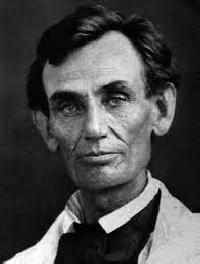
Two years after Fr?monts defeat, Abraham Lincoln won his partys nomination to the U.S. Senate. This put him head to head in a race with the powerful senator Stephen A. Douglas, one of Lincolns rivals from his days in the Illinois state capital, who was running for a third term as a Democrat. There followed a series of seven debates between Lincoln and Douglas in towns across Illinois over the next seventy days. Several factors helped to attract national attention to the campaign battles. First, Douglas, one of the key figures behind the Compromise of 1850, enjoyed a reputation as the Little Giant of the Democratic Party and its best stump speaker. Second, the national debate over slavery was reaching a boiling point. During the four years leading up to these historic debates, Americans had witnessed some incredibly violent and explosive events that were sharply dividing the nation. Responding to the fervor, journalists accompanied the candidates, writing articles detailing the debates and offering editorial commentary that was unprecedented in American political history. The whole country watched the debates unfold.
26. Political Motives

A leader of the Democratic Party, Douglas had made himself politically vulnerable when he broke with Democratic President James Buchanan and southern Democrats over the issue of Kansas statehood. Douglas opposed the admission of Kansas as a slave state under the terms of the controversial, proslavery Lecompton constitution. That constitution, which was widely believed to have been the result of voter fraud by Missouri border ruffians, would have legalized slavery in the new state. Douglas, hoping to appeal to antislavery northern Democrats and Republicans, took a popular sovereignty stance and opposed the constitution as unrepresentative of the majority opinion in Kansas. Enraged southern Democrats accused Douglas of party treason.
Lincoln understood that he would have to take a high moral ground to undermine the temptation of some Republicans to vote for Douglas as a means of dividing the national Democratic Party. To this end, Lincolns campaign began with his famous House Divided Speech delivered in Springfield, Illinois, on June 16, 1858. Recognized as one of the most important speeches in American history, his powerful message warned that the crisis over slavery would not be resolved until the nation stood either completely slave or totally free. A house divided against itself cannot stand, he declared, in prophetic words that supported the irrepressible conflict doctrine. He then turned on Douglas by saying that the threat to the nations unity came principally from Douglass popular sovereignty perspective. Lincoln envisioned a dozen Bleeding Kansas episodes in which settlers fought over the issue of slavery in order to get the upper hand in the territories.
27. A Constitutional Moral or Local Issue

Furthermore, Lincoln charged Douglas with being part of secret cabal to extend slavery to the free states. He boldly announced that slavery was simply immoral and had to be dealt with forthrightly by the U.S. Congress. For Lincoln, slavery violated the fundamental assertion of the Declaration of Independence that all men are created equal. He argued that its continued existence and support in the nation ran counter to the wishes of the Founding Fathers. Ultimately, only the power of the federal government could resolve the issue by extinguishing slavery from the nation. Although Lincoln contended that there existed no constitutional way of interfering with slavery where it presently existed, he believed that it should not be allowed to expand westward. For him, the matter was a question of right and wrong, with Douglas indifferent to a moral wrong.
Douglas met the challenge by trying to portray Lincoln as a radical abolitionist. He disagreed with Lincolns claim that the Founding Fathers had opposed slavery, pointing out that many of them, including George Washington and Thomas Jefferson, had owned slaves. He played down the moral issue in favor of his commitment to a Jacksonian egalitarianism for white Americans, saying that the power to decide about the existence of slavery should be left to each community and on the local level. And he argued that slavery in any case would never survive outside of the South for simple economic reasons. Douglas asserted in his Freeport Doctrine (delivered at Freeport, Illinois) that the people could keep slavery out of their territories. Despite the Dred Scott decision by the Supreme Court, which defended the property rights of slaveowners, Douglas claimed that local communities could decide for themselves to not pass local police laws to preserve the institution of slavery and not to protect slaveowners. He warned the nation not to try to judge political issues on moral grounds lest emotions spill over into civil war. Ultimately, Douglas argued that the issue came down to conflicting ideologies a view of the nation as a confederacy of sovereign and equal states versus a federalist empire of consolidated states. He accused Lincoln of being an abolitionist at heart, and a dangerous fanatic whose policies would result in racial consolidation and racial equality. In doing so, Douglas appealed shamelessly to the race prejudice of Illinois voters.
28. Limited Racial Equality

It was on this last issue of racial equality that Lincoln had the most difficulty in answering Douglas. Lincoln could not easily declare that slavery was immoral and that African Americans were endowed with God given rights as presented in the Declaration of Independence without leaving himself vulnerable to Douglass race baiting attacks. Either African Americans were equal to white Americans, Douglas proclaimed, or they were not. Lincoln answered by trying to contend that there were physical and social differences between the races that would probably forever forbid their living together upon the footing of perfect equality. On the other hand, true to his free labor Republican ideology, Lincoln insisted that there is no reason in the world why the Negro is not entitled to all the natural rights enumerated in the Declaration of Independencethe right to life, liberty, and the pursuit of happiness. Nevertheless, he saw limits to what this meant. Like most other Republicans, he opposed granting blacks the rights to vote, sit on juries, hold public office, or intermarry with whites. Blacks were equal, he said, to all men in their freedom to earn the just rewards for the work they did rather than to have those earnings confiscated by tyrants, kings, and slavemasters.
In those days, U.S. senators were elected by their state legislatures, not by a direct popular vote. Thus, the debates were designed to appeal to voters who would elect members of the state legislature, who would in turn elect the U.S. senator from Illinois. When the votes were counted, although Republican candidates won a slight plurality of the popular vote, the malapportionment of legislative districts favored southern Illinois, where the Democrats were strongest. As a result, the Democrats retained their majority in the legislature and elected Douglas over Lincoln by fifty four votes to forty six. Nevertheless, the campaign had given Lincoln a national reputation and made him a leader of the Republican Party.